
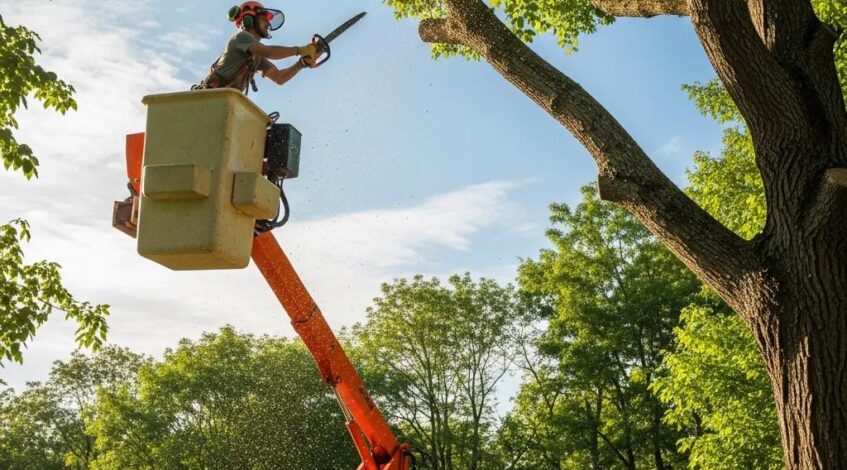
Ask three companies what it costs to trim the oaks in a Hot Springs yard and you may hear three numbers that sound like they belong to three different jobs. One bid comes in at $250, another at $700, and a man on Facebook Marketplace says he can do the whole yard for $100 cash. The spread is confusing, and it stays confusing until a homeowner understands what actually drives tree trimming cost. This guide lays out real 2026 ranges for Central Arkansas, explains what moves a quote up or down, and shows how to compare bids so the low number does not become the expensive one.
What tree trimming costs in Central Arkansas in 2026
Most professional tree trimming in the Hot Springs area falls between $200 and $1,000 per visit. The range is wide because trees are wide. A ten-minute cleanup on a dogwood and a full day in the canopy of a 70-foot white oak are both called “trimming,” and they are not the same job.
Here is how the range typically breaks down by tree size:
- Small trees, under 25 feet. Dogwoods, crape myrtles, young maples, ornamental fruit trees. Most of the work happens from the ground or a short ladder. Typical range: $200 to $400.
- Medium trees, 25 to 50 feet. Mature Bradford pears, sweetgums, mid-sized pines and oaks. A climber or a lift enters the picture, and so does rigging for limbs over anything breakable. Typical range: $350 to $700.
- Large trees, over 50 feet. The mature post oaks, white oaks, and loblolly pines that shade most established Garland County neighborhoods. Every cut happens high, every limb needs a plan for where it lands, and the crew below is managing ropes all day. Typical range: $600 to $1,000, and complex large-tree work runs above that.
Multiple trees change the math in the homeowner’s favor. Once a crew has the equipment set up and the trailer on site, the second and third trees usually cost less per tree than the first. Anyone with four or five trees needing attention should price them as one visit, not five.
One honest caution about these numbers: they are typical ranges, not quotes. No company can price a tree it has not looked at, and the ones who try are guessing with your money.
What moves the price up or down
Two oaks of the same height can come in hundreds of dollars apart. These are the factors an estimator is weighing while walking a property:
Height and spread. Taller trees take longer to climb, demand more rope work, and put every cut farther from the ground. Price follows time and risk, and both climb with the tree.
Access. A tree in an open front yard where a bucket truck can park underneath is the easy version. A tree behind the house, inside a fence, or on one of the steep lots common around Lake Hamilton means climbing, hand-carrying gear, and roping brush out piece by piece. Tight access can add 25 to 50 percent to a job.
What is over and under the tree. Limbs hanging above a roof, a fence, a parked boat, or a service line cannot simply be cut and dropped. They get tied off, cut, and lowered under control. That care is exactly what a homeowner is paying for, and it takes time.
The type of trimming. Deadwood removal, taking out the dead and dying limbs before they fall on their own, is usually the most direct work. Crown shaping and thinning take more cuts and more judgment. Storm-prep thinning, which reduces the sail area of the canopy so wind moves through instead of pushing against it, sits in the middle and is some of the best money a Central Arkansas homeowner can spend before spring storm season.
Condition of the tree. A neglected tree full of deadwood, crossing limbs, and storm damage takes longer than one maintained on a regular cycle. First visits after years of no attention tend to sit at the top of the range. The visits after that cost less.
The math on trimming now versus waiting
Trimming feels optional in a way removal never does, which is why it gets put off. The numbers say otherwise.
Professional removal of a large tree in Arkansas commonly runs from around $1,500 to well past $3,000 once size and access are factored in. The full breakdown is in the 2026 Arkansas tree removal pricing guide, but the short version is that removing a big oak costs several times what maintaining it does.
A maintained tree is simply less likely to reach that point. Regular trimming takes weight off overextended limbs, removes the deadwood that invites rot and insects, and lets an experienced climber lay eyes on the whole canopy every couple of years. Problems get caught while they are still trimming problems. An unmaintained tree carries its dead limbs until a storm brings them down, and by the time decay shows from the ground, the conversation has often moved from a $500 trim to a four-figure removal. Waiting does not save the money. It defers the bill and lets it grow.
How to compare trimming quotes
The goal is not the lowest number. It is the most complete one. Here is what separates a real quote from a guess:
- It is written. A figure quoted through a truck window is not an estimate, it is an opening position. Get the scope and the price on paper.
- It says what is being done. “Trim trees, $400” tells a homeowner nothing. A real estimate names which trees, what kind of work (deadwooding, thinning, clearance from the roof), and roughly how much comes out of the canopy.
- Cleanup is spelled out. Hauling brush and limbs is a real cost. Some low bids get low by leaving the debris in the yard. Confirm haul-off is included.
- Proof of insurance comes without friction. Trimming means people and chainsaws working above your house. A professional outfit expects the question and has the certificate ready. This is where the Facebook Marketplace price stops being a bargain, because if an uninsured worker gets hurt on the property, the homeowner can end up owning that problem.
- Nobody offers to “top” the tree. Topping, cutting the main upper limbs off flat, is the mark of a crew that does not understand trees. It stresses the tree, invites decay, and produces weakly attached regrowth that becomes tomorrow’s hazard. Any bid built around topping should be set aside no matter how good the number looks.
A homeowner who gets two or three written estimates and reads them side by side will usually find the price differences explain themselves in the scope.
The only reliable number is a written estimate
Every figure in this guide is a typical range for Central Arkansas, useful for planning and for spotting a bid that is far out of line in either direction. The real number depends on the trees standing in one specific yard, and that takes an experienced set of eyes on site. A reputable company provides that look for free, in writing, with no obligation attached.
Talk to a local Hot Springs tree service
Clower Tree Service is a family-owned crew based in Hot Springs, led by owner Paul Clower, and bonded and insured for exactly the kind of work described above. The crew handles tree trimming and pruning across Hot Springs, Hot Springs Village, Malvern, and the rest of Garland County, from single-tree deadwooding to whole-property storm prep.
For a free written estimate on trimming, call 501.538.1606 or email info@clowertrees.com. A short walk around the property is all it takes to turn these ranges into a real number.