
By late July in Garland County, the pattern is familiar. Three weeks without real rain, afternoons parked above 95, and the big water oak that shaded the deck all spring starts looking tired. Leaves brown at the edges. A few drop early. The canopy that was dense in May shows daylight through it.
Homeowners see that and worry the tree is dying. Most of the time it is not. Drought stress in trees is a survival response, not a death sentence, and a mature oak that has stood through forty Arkansas summers has been through this before. The useful skill is telling ordinary summer stress from genuine decline, because the two call for very different responses. The first just needs water and time. The second is worth a professional look before September storms roll in.
Here is how the crew at Clower Tree Service reads a stressed tree in July, and what actually helps.
What drought stress in trees looks like
A tree short on water does not wilt all at once like a tomato plant. It sheds load in stages, and each stage is visible if you know what to look for.
Leaf scorch. Browning that starts at the leaf edges and works inward between the veins. The tree is losing water through its leaves faster than the roots can replace it, so the tissue farthest from the veins dries out first. Scorch looks alarming and is usually the least serious symptom on this list.
Early leaf drop. A stressed tree will deliberately drop a portion of its leaves in July or August to cut its water demand. Finding leaves on the ground in midsummer feels wrong, but it is closer to a budget cut than a collapse. Oaks, hickories, and sycamores around Hot Springs do this in nearly every dry year.
Wilting that does not recover overnight. Leaves drooping at 4 p.m. on a 100-degree day mean very little. Every tree droops in that heat. The signal worth noting is morning wilt. If leaves are still limp at 7 a.m. after a cool night, the tree could not rehydrate, and the soil around its roots is genuinely dry.
Canopy thinning. Fewer leaves, smaller leaves, and a see-through look in a crown that used to be dense. In a single dry summer this is a defense measure. The same thinning returning year after year is a different story, covered below.
All four of these can show up on a tree that will leaf out fine next April. Stress is not the same thing as decline.
Survivable stress or real decline
The difference usually comes down to where the damage sits and whether it reverses.
Scorched leaves are spent, but the buds behind them are typically alive. Early-dropped leaves get replaced next spring. A thinned canopy on an otherwise sound tree fills back in over a season or two of normal rain. That is stress, and most trees carry it without lasting harm.
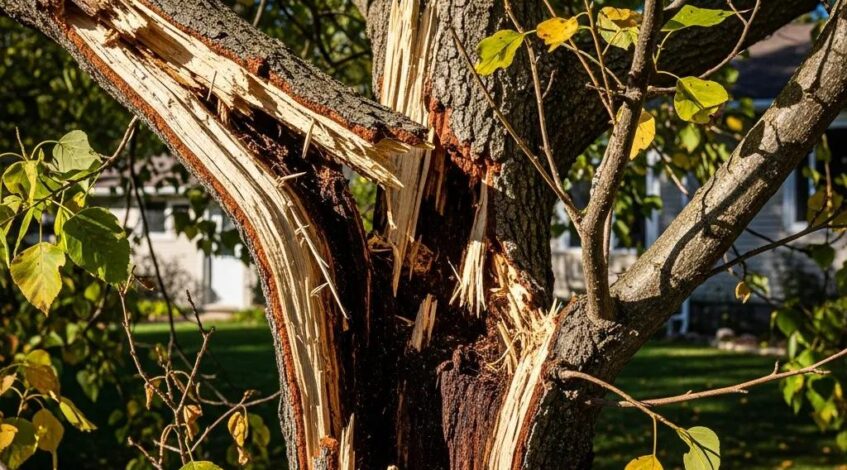
Decline shows up differently. The clearest flag is a whole limb going bare while the rest of the canopy holds its leaves, especially a large limb high in the crown. Dieback that starts at the top and the branch tips and works inward is the classic pattern. A limb that produced no leaves at all this year is not resting, either. It is done, and it is now a brittle weight waiting on a storm.
Repetition matters too. One rough July is weather. Three thinning summers in a row means the root system or the tree’s plumbing has a problem that rain alone is not fixing. And on mature oaks around Central Arkansas, repeated drought can open the door to a slow spiral where heat, root injury, and opportunistic pests and fungi stack on each other. Upper-crown dieback plus sprouts popping from the trunk or big limbs is the combination worth taking seriously on any large oak.
A tree showing these signs is not doomed. It has simply moved past watch-and-wait, and the next look it gets should come from someone qualified to judge what stays and what goes.
Deep watering a mature tree, done right
Deep watering is the front-line answer to drought stress in trees, and most people do it wrong in the same two ways: too shallow and too close to the trunk.
The feeder roots that actually drink sit in roughly the top foot of soil, out near the drip line, the ring on the ground below the outer edge of the canopy. Water at the trunk does almost nothing except keep the bark wet, and a daily ten-minute sprinkle never gets past the surface.
What works is a slow soak. Lay a garden hose at a trickle out near the drip line and let it run for a few hours, moving it around the circle as you go, once every week or two during a dry stretch. The goal is moisture a full 8 to 12 inches down, which you can check by pushing a long screwdriver into the soil. It slides easily through damp soil and stops hard in dry.
Mulch earns its keep in a drought, with two rules. Keep it 2 to 4 inches deep in a wide ring, and keep it pulled back from the trunk itself. A mulch volcano piled against the bark holds moisture against the trunk and invites rot, which trades a drought problem for a worse one.
One honest caution: a tree that has already dropped half its canopy will not green back up in August because it got watered twice. The payoff for deep watering is next year’s canopy and the tree’s ability to defend itself. Think of it as protecting the recovery, not reversing the damage.
Not sure whether yours is stress or decline? A quick look from a local crew is free, and it beats guessing. Call 501.538.1606.
Why stressed limbs break when the storms come back
Late summer in Arkansas runs on a hard rhythm. Weeks of drought, then a line of storms with 60 mph gusts.
Drought-stressed wood handles that badly. Limbs that died over the summer have gone brittle. Live wood that spent two months short on water is less flexible than it was in May. And a thinned canopy changes how wind moves through a tree, loading branches in ways they are not used to carrying. After an August storm, the calls come in: big limbs down on roofs, fences, and driveways, most of them limbs that were visibly dead or dying back in July.
That is the practical reason to deal with dead wood before storm season peaks. Removing dead and weakened limbs from a stressed tree is standard tree trimming and pruning work, and it is far less expensive than the roof repair that follows the alternative. Timing and restraint matter on a stressed tree, though. Heavy pruning of live wood in a drought adds injury on top of stress, so the job is to take what is dead or dangerous and leave the rest for a better season. That judgment call is exactly what an experienced crew is for. And when drought has finished a tree outright, planned tree removal before storm season beats cleaning one off the roof after it.
When to get a professional look
Plenty of drought stress needs no professional at all. Water deeply, mulch properly, and wait for rain. A call is worth making when:
- A large dead limb hangs over the house, a driveway, a play area, or a neighbor’s property.
- A big oak shows the decline pattern: upper-crown dieback, trunk sprouts, thinning that repeats each year.
- A stressed tree also leans, or the soil at its base has lifted or cracked.
- You simply cannot tell whether a limb is dead or dormant, and it is positioned where a mistake would be expensive.
Clower Tree Service handles tree trimming, removal, and hazard assessment across Garland County. The family-owned crew is bonded and insured, and Paul Clower has read enough stressed Garland County oaks to know that most of them pull through. His standing instruction on stressed trees is the same one behind this article: save what can be saved, remove only what the tree or the situation genuinely requires.
Talk to a local Hot Springs tree service
If a tree on your property has had a hard summer and you want a straight answer about what it needs, that answer is free. Clower Tree Service serves Hot Springs, Hot Springs Village, Malvern, and the surrounding Central Arkansas area.
Call 501.538.1606 or email info@clowertrees.com for a free estimate. Most stressed trees recover. The crew will tell you plainly whether yours is one of them, and handle it safely if it is not.